It cannot verify every fact
A spoken draft may present an incorrect name, date, claim, or instruction with a confident tone.
Workaround
Check factual statements against trusted source material before publication.
Use case guide
These voice ai examples free show how a simple idea can become a usable draft for narration, learning materials, accessibility content, or short-form media. Start with a clear purpose, then review the result before sharing it.
Voice work often stalls between a good idea and a usable draft. The following three steps keep the task focused without treating generated audio as final by default.
Write down who will hear the audio, where it will be used, and what the listener should understand or do afterward. This prevents vague prompts and unnecessary rewrites.
Describe the script, tone, pacing, and pronunciation needs in plain language. Keep the first request narrow so you can assess the output instead of trying to solve a whole production at once.
Listen for errors, awkward emphasis, missing context, and unintended meaning. Revise the wording or voice direction, then label generated material clearly when your audience or organization requires it.
These related guides cover the broader terms and tools behind the examples, so you can move from a use case to a more specific next step.
A useful draft is not only about sound. It also needs a clear purpose, an audience-appropriate script, and a review path before publication.
Starting material
Manual starting point
Blank page, notes, or a rough script
Voice AI workflow
A defined purpose plus a short, specific prompt
First draft
Manual starting point
Written and recorded from scratch
Voice AI workflow
A generated voice draft for review
Pacing decisions
Manual starting point
Estimated while writing or recording
Voice AI workflow
Specified with pauses, emphasis, and sentence length
Revision loop
Manual starting point
Re-record each major change
Voice AI workflow
Adjust the script or direction, then create another draft
Quality check
Manual starting point
Often depends on the creator alone
Voice AI workflow
Listen for pronunciation, tone, timing, and factual clarity
Audience fit
Manual starting point
May be considered late in production
Voice AI workflow
Defined before generation and checked before sharing
Final responsibility
Manual starting point
Owned by the person recording
Voice AI workflow
Still owned by the person or organization publishing it
The before-and-after view represents a change in production readiness, not a guarantee that every generated result is publishable without editing.
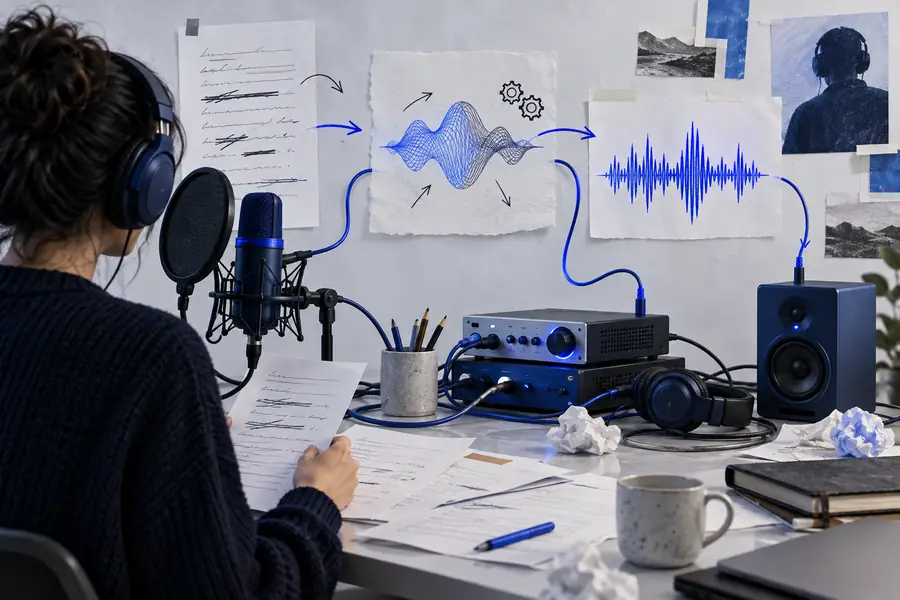 Rough idea
 Reviewed voice draft
Examples can demonstrate a workflow, but they cannot remove the need for judgment. Keep the following limits visible when planning a real project.
A spoken draft may present an incorrect name, date, claim, or instruction with a confident tone.
Workaround
Check factual statements against trusted source material before publication.
A familiar voice, private recording, copyrighted script, or identifiable person may involve rights that a tool cannot grant.
Workaround
Use approved material and obtain the permissions your project requires.
Tone, vocabulary, pacing, and cultural context that work for one group may confuse or exclude another.
Workaround
Define the audience in the brief and have an appropriate reviewer listen.
Pronunciation, emphasis, emotional nuance, and timing may still need correction, especially for names, specialist terms, or sensitive subjects.
Workaround
Use a short test, provide pronunciation guidance where supported, and edit or replace unsuitable passages.
Choose one small use case, write the listener and outcome into the prompt, and treat the first result as a draft. A focused test makes it easier to judge clarity, tone, and whether the output belongs in your project.
Try a voice workflowAnswers to common questions about using examples to evaluate a voice workflow.
Begin with a short narration, a study explanation, an accessibility draft, or a social video voiceover. These tasks have a clear audience and outcome, making it easier to judge whether the result is understandable and appropriately paced.
You can use a draft as a starting point for instructional material, but review the facts, pronunciation, pacing, and accessibility of the result. Follow your school or organization’s rules for disclosure, rights, and approval before distributing it.
An example can help you test a commercial workflow, but the example itself does not establish usage rights or licensing terms. Check the applicable product terms and confirm that your script, voice choice, and intended distribution are authorized.
Give the task a specific audience, purpose, tone, and approximate length instead of asking for a generic voice. Use short sentences, identify names or technical terms that need care, and revise after listening to the first draft.
Disclosure depends on the context, audience, organization, and applicable rules. When people could reasonably mistake generated audio for a person’s original recording, clear labeling is a prudent part of responsible publishing.